
News
Journey to Planet Earth: Dispatches from the Gulf
 On April 29, 2016 ADDOMEx hosted a screening of “Journey to Planet Earth: Dispatches from the Gulf” on the Texas A&M University at Galveston campus. This documentary investigates the environmental health of the Gulf of Mexico six years after the Deepwater Horizon blowout in April 2010. The documentary was followed by a panel discussion with researchers who are studying impacts of the oil spill. There were three panelists (from left to right, Dr. Ron Eytan (DEEPEND), Chris Hale (Sea Grant), and Dr. Peter Santschi (ADDOMEx)), approximately 50 attendees, and lots of fantastic questions and comments. All three organization set up booths in the lobby outside the screening room so that guests could learn more details about each group before and after the event.
Creep into the DEEPEND: Deep-Pelagic Nekton Dynamics of the Gulf of Mexico
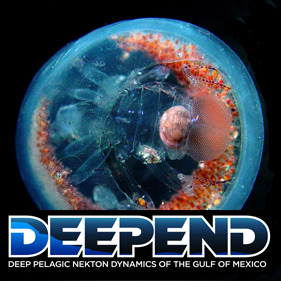 The Oceanscape Network at the Oregon Coast Aquarium has joined forces with WhaleTimes Inc. for an exploration of the deep sea featuring the DEEPEND consortium. The 2016 exploration will run from June 6 to 10 on both the Oceanscape and Whaletimes websites. Mark your calendars to this exciting virtual exploration to the deep sea!
Read more about this program here
The Strange Scanning Eyes of a Swimming Sea Snail
 We know about many bizarre visual characteristics of animals living in the dim light of the deep sea. One of the strangest such adaptations is the scanning eye of an atlantid heteropod mollusc. Heteropods are snails that spend their entire lives swimming in the open ocean. [Heteropods are sometimes called Sea Elephants, and are also known as pterotracheoids.]
GOMRI Features DEEPEND : Smithsonian Highlights Creatures Stranger than Fiction in the Gulf of Mexico
 The Smithsonian posted an article about deep-sea research, using eye-popping photography to make the unreal real.
The article features the work of scientists with the consortium Deep-Pelagic Nekton Dynamics of the Gulf of Mexico, or DEEPEND. These researchers are working to improve our understanding of deep-water life and processes since the Deepwater Horizon oil spill in habitats near the vicinity where the spill occurred.

- 8000 N Ocean Drive
- Dania Beach, FL 33311
- 954-262-3600
- admin@deependconsortium.org