
Cruise Blog
Subscribe to our Blog
It’s a Crust Eat Crust World!
Hi everyone! Stormie Collins, a post-doc in Heather Bracken-Grissom's lab at FIU and I am going to chat about my favorite group of animals- crustaceans!
Life has evolved countless strategies for survival. When we think about life in the deep sea, we often picture animals navigating the water column, swimming through the darkness to find food and mates as they complete their life cycles. While this is a successful strategy for many animals, others have evolved a very different approach: let somebody else do the swimming for you.
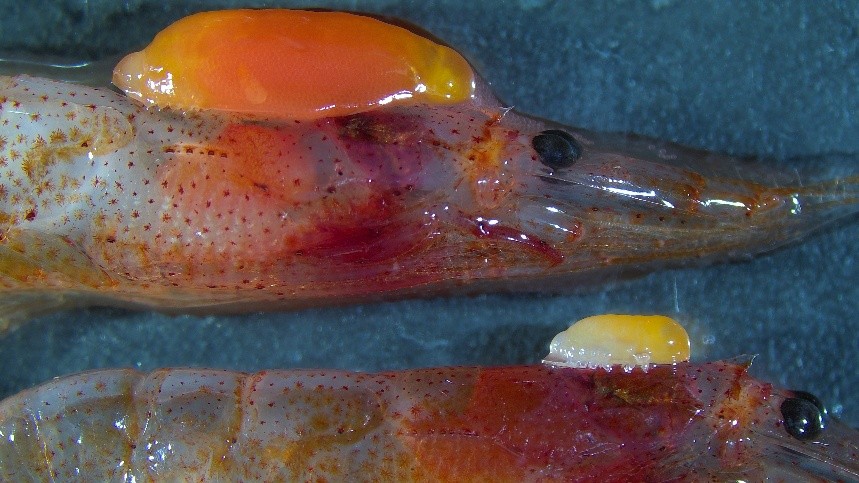
Figure 1. Dajid isopods parasites on sergestid shrimps (photo: SC)
Parasites make their living on, or inside of, another animal, relying on a host for food, shelter, or even transportation. Among deep-sea crustaceans, parasitic isopods have evolved some particularly bizarre ways of accomplishing this. Some live within the protected gill chambers of their hosts, while others attach directly to the outside of the animal and feed using highly specialized mouthparts. Once attached, these parasites can remain with their host while the shrimp continues swimming, feeding, and migrating through the water column.
On this cruise, we have encountered several striking examples. Some of the most conspicuous are dajid isopods attached to sergestid shrimps and mysids. These tiny crustaceans live on the backs of much larger crustaceans, where their specialized mouthparts pierce through the host's exoskeleton and allow them to feed from the tissues beneath. From a distance they can look like little bumps on the animal, but under the microscope it becomes very clear that there is an entire second crustacean hitching a ride on its host.
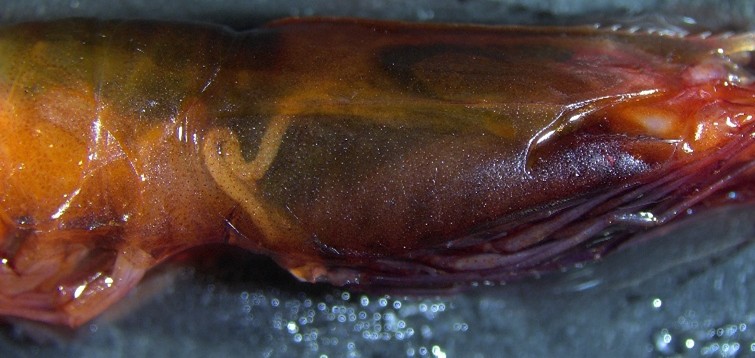
Figure 2. nematode in the body cavity of an acanthephyrid shrimp (photo: SC)
And crustaceans are not the only parasites we've encountered. Several shrimps have contained bright pink nematode worms coiled within their body cavities, a particularly unpleasant surprise when examining an otherwise transparent animal beneath the microscope. Because many deep-sea shrimps have transparent or red bodies, these internal passengers can sometimes be seen without dissecting the host, but sometimes remain hidden until they begin to crawl out of their host. Gross? Absolutely. Fascinating? Also absolutely.
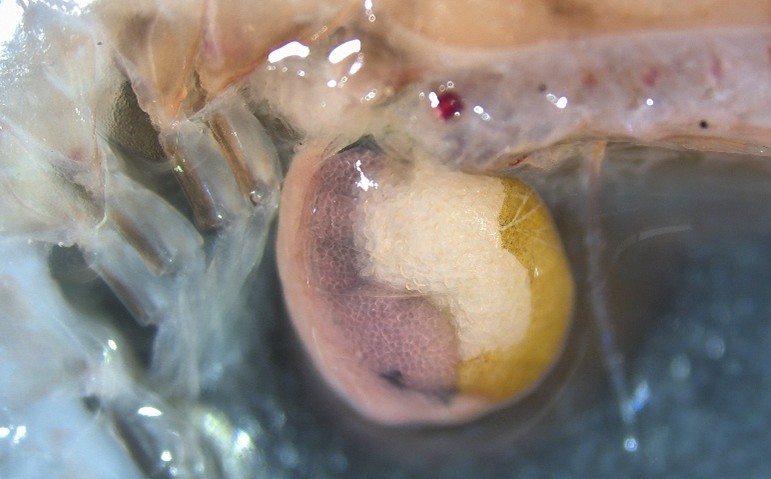
Figure 3. unknown parasite on the abdomen of a krill species (photo: SC)
Perhaps one of our strangest finds has been a growth attached to the abdomen of a krill that appears consistent with a parasitic barnacle, possibly a rhizocephalan. Rhizocephalans are among the most unusual crustaceans on Earth. Although their relatives include familiar barnacles attached to rocks, adult rhizocephalans become so highly modified for parasitic life that they barely resemble crustaceans at all. Rather than living as a recognizable barnacle, they exploit another crustacean as their host and devote much of their adult lives to feeding and reproduction.
These parasites may make us squirm, but they are also part of the remarkable biodiversity of the deep sea. Every shrimp, mysid, or krill we collect is potentially an ecosystem of its own, carrying organisms that have evolved alongside their hosts in ways we are only beginning to understand. Sometimes documenting biodiversity means identifying the animal in your net, and sometimes it means taking a closer look at what's living on or inside of it

- 8000 N Ocean Drive
- Dania Beach, FL 33311
- 954-262-3600
- admin@deependconsortium.org