
Cruise Blog
Subscribe to our Blog
The Curious Case of Swim Bladders in the Deep Sea
It’s Ian back again for my second research cruise and my first Deep-Sea Benefits cruise. In my last post I gave you all a little overview of the acoustics program here on the ship but today I’m going to dive in a little deeper and discuss everyone’s favorite topic… bladders or more specifically swim bladders.
Swim bladders or gas bladders are basically gas-filled sacs present in the body of many fishes and they are used to maintain and control buoyancy. While gas bladders and fisheries acoustics may seem completely unrelated, they are actually quite intertwined. This is because fishes that possess gas bladders are much stronger “scatters” of sound than organisms that do not possess them which is due to the large difference in density between the gas of the bladder and the surrounding sea water. As a result, at lower frequencies swim bladdered fish may be the predominant organisms present in our echograms. For instance, in the 18kHz echogram (Picture 1) the layer we observe is likely swim bladdered fish while in the 38kHz echogram (Picture 2) this layer is likely crustaceans or nonswimbladdered fish.
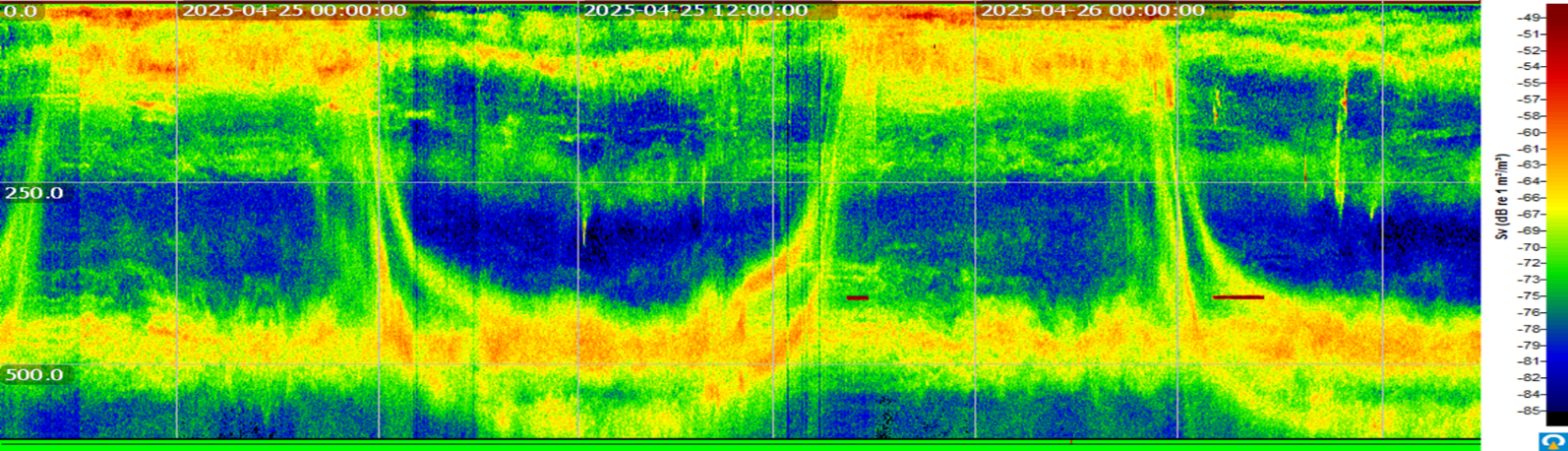
18 kHz Echogram
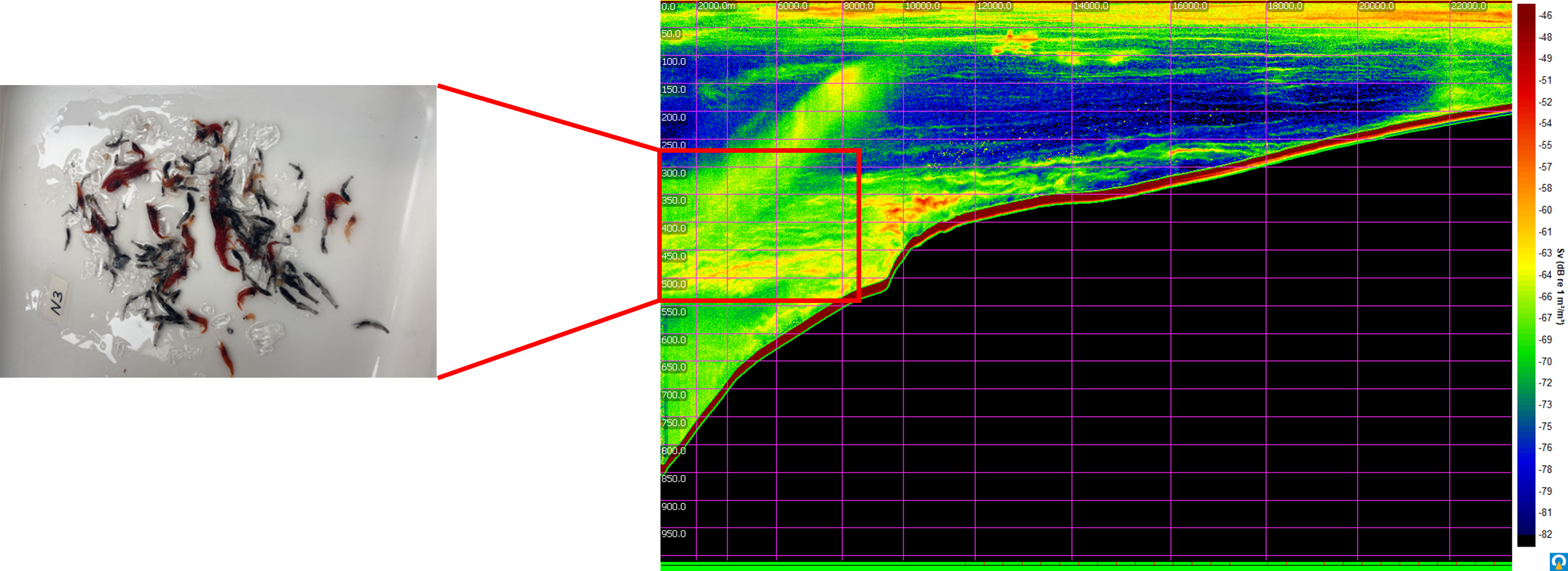
38 kHz Echogram
Whether or not a fish has a gas bladder may seem like a very simple yes or no question but with mesopelagic fishes its actually a bit more complicated as many mesopelagic fishes start out life with one but many lose it completely by the time they are fully grown. Additionally, whether or not certain species have gas bladders is also a mystery. Both of these things are problematic for interpreting our acoustic data and also modeling the fish’s acoustic scattering response which is part of what my current research is focused on. To try to give more insight into these questions I am planning on CT scanning many of the fishes we catch in order to gain insights into whether certain species have gas bladders and whether they change as these fishes age. All of this will hopefully help improve our acoustic modeling efforts and improve our interpretation of our acoustics data. Also, it gives me an excuse to spend some more quality time with these fascinating organisms.
Aside from pondering swim bladders and assisting with the shipboard acoustics I am also part of a collaboration with fellow PhD student Nina Ramos where we are trying to combine acoustics and eDNA together which is super exciting. You’ll get to hear a bit more about this project from Nina in a future post so look out for that in a few days. The cruise so far has been amazing as I write this we have just left Viosca Knoll and all of its silky sharks and are steaming towards DeSoto Canyon an undersea canyon where we will continue with our survey. Super excited to see what comes next!
-Ian

- 8000 N Ocean Drive
- Dania Beach, FL 33311
- 954-262-3600
- admin@deependconsortium.org